
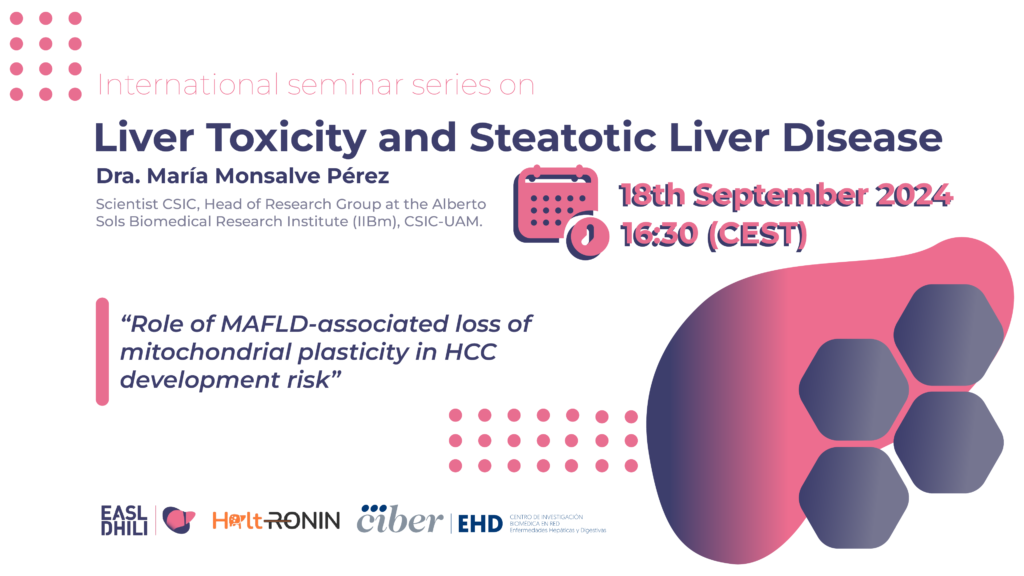
We warmly welcome you to the International Seminar Series on Liver Toxicity and Steatotic Liver Disease. To improve our understanding of the topic and to promote collaboration in our research efforts, we will be organising a series of seminars each month.
Next week, we have a new session, on 18th September (Wednesday) from 16:30h to 17:30h (CEST). Your participation is vital to enrich the discussions, and we look forward to hearing your ideas.
|
Graduated in Biology in 1993 and PhD in Biochemistry and Molecular Biology by the UAM (Madrid, Spain) in 1997. Following a postdoctoral stay at the Dana Farber Cancer Institute in Boston (MA, USA), returned to Spain with a Ramón y Cajal contract that allowed her to develop her own research line first within the group of Santiago Lamas at CIB, CSIC (Madrid, Spain) and then as independent group leader at CNIC. From 2011 she joined the IIBM, CSIC-UAM first as Científico Titular CSIC and then as Investigador Científico CSIC where she leads the Mitochondrial Function in Health and Disease group. She is currently Council Member of the SEBBM, Vicedirector of GEIRLI, member of SED and e-mit as well as the COST action CA20121.
Liver steatosis is a highly prevalent condition associated with the metabolic syndrome that can progress to metabolic associated fatty liver disease (MAFLD) and is a mayor risk factor for hepatocarcinoma (HVV) development. MAFLD is characterized by the presence of fibrosis, inflammation as well as mitochondrial dysfunction and oxidative stress. However, the contribution of mitochondria to disease progression and HCC development remains to be stablished. To that address this question we studied the effect of high fat diet and teratogen administration on a mouse model of mitochondrial dysfunction, deficient in the protein PGC-1α, a master regulator of mitochondrial function. Our data suggest that PGC-1 α deficiency facilitates HCC development and this effect is likely related to a deficient capacity to respond to cellular damage, highlighting the critical role played by mitochondria in the cellular response to stress and its impact on HCC.
|