
Program
Event day 27/06/2024
Event day 28/06/2024
Minutes
After the
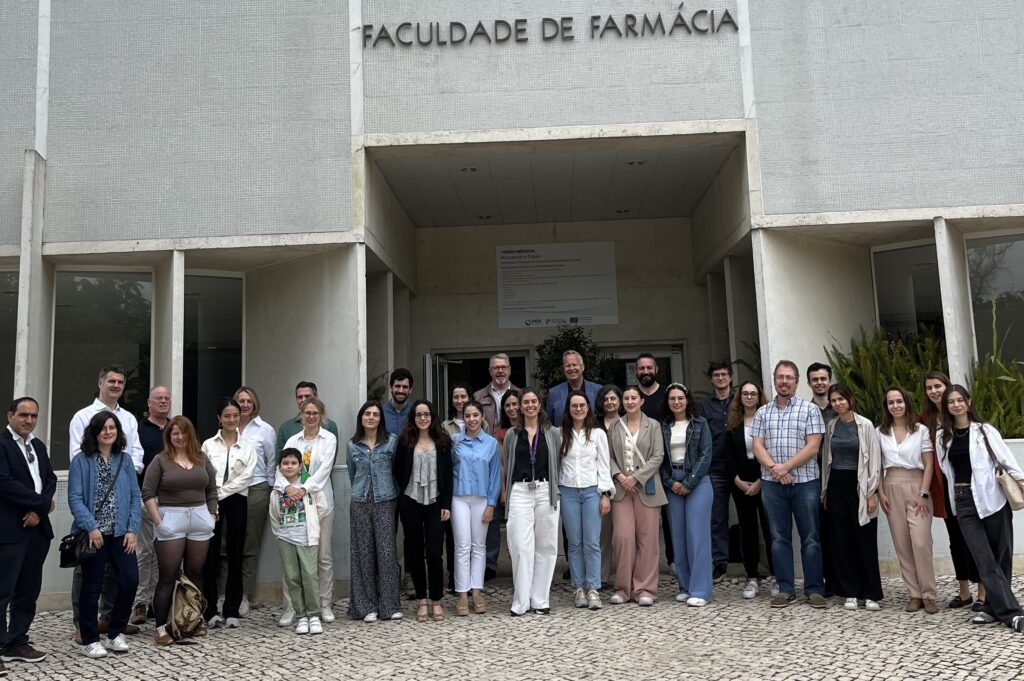
assistants arrived at the Faculty of Pharmacy of the University of
Lisbon-Research Institute of Medicines, Joana P G Miranda (FFUL, Lisbon,
Portugal) started the event by welcoming members of the Consortium.
Prof. Javier
Cubero (UCM, Spain) started the meeting with a brief introduction & overview of the
HaltRONIN Consortium. He introduced the partners of the Consortium, the WP
division, and project objectives. After this introduction, Prof. Cubero
continued with the WP1; in this presentation, he exposed the WP’s goals, tasks,
ongoing tasks and next steps. He also announced that Anaxomics is going to
leave the project.
The second
session begins with Leonard Nelson (UEDIN, UK) presenting an
overview of the WP2 leader. He told about the WP2 objectives and tasks and
explained the work carried out by each partner of this WP. Also, he presented
the milestones and deliverables for this WP. He finished his presentation with
the key performance indicators and Key success criteria.
Raquel García
de la Torre, (FCRB-CERCA, Spain) continued to present the Building iPSC-derived liver models for MASLD. In
this presentation, Raquel told about the generation of iPSCs from patients with
early NAFLD (F1) and advanced NAFLD (F4); the comparison of these to healthy
lines, generation of Hepatocyte like cells (HLCs), Stellate cells (HSCs),
Kupffer Cells (KCs) and Liver sinusoidal endothelial cells (LSECs), and the
optimization of media for co-culture. she finished the presentation introducing
the following steps: Generation of patient specific iPSC cell line with SNPs for PNPLA3 and MBOAT7 gene,
optimization of a hepatoblast differentiation system from iPSCs,
characterization and adjustment of cell ratios of the 4-cell-type spheroid model for downstream studies,
optimization of the MAFLD media for the stimulation of the co-cultures.
After this
presentation, Joana P G Miranda (FFUL, Portugal) introduced her
presentation, “Characterization and Validation of human in vitro models with
hepatic functional and phenotypic markers”. In this, Joana explained the work
developed by FFUL regarding Task 2.1: Develop patient-derived iPSC-based liver
models; optimization of the hepatic differentiation protocol iHLCs and iMacs;
development of the human liver-chip model for Modelling health-to-disease
transitions; design of a fit-for-purpose microfluidic device (MD); development
of the human liver-chip-cell chamber optimization, cell morphology and presence
of hepatic markers, cell functionality. She continued her presentation talking
about their developed work in task 2.2: Characterization and Validation of
human in vitro models with hepatic functional and phenotypic markers. And she
finished with task 2.3: Develop SOPs for induction of MASLD-MASH transition;
evaluation of a more physiological medium; reducing glucose, insulin and
dexamethasone concentrations enhances the hepatic phenotype and cell; HLCs in
Physiol display increased ATP production and maximal mitochondrial functional
capacity, only HLCs in Phisiol present insulin-responsive glucose metabolism,
and testing MASLD induction.
We continued
with the Michel Kranendonk (UNL, Portugal) presentation “HepaRG based
multi-cell-type liver organoid: the role of POR in the MASLD-MASH transition”.
He introduced the key pathways addressed in Halt-RONIN and said that UNL is
focused on POR: cytochrome P450 oxidoreductase (CPR) because it is the central
controller of many physiological processes. He also told about the Thyroid
hormone receptor beta and POR expression, the genetic variability POR
(ClinVar-and gnomAD-data base). He continued discussing the UNL participation
in the project (objectives, experimental tasks and the results so far). At
last, he mentioned the ongoing tasks and the next steps.
According to the programme, Leonard
Nelson (UEDIN, UK) presented the development of LiverAce: Human liver
acinar models to study health-to-disease (MASLD-MASH) transitions. In this, he
showed the progress of WP2 in each of its tasks marked by the project and the
plan to follow. He told about the aims of their work: comparator co-cultures:
2D HepaRG/ Transwell “2.5D” HepaRG: endothelial cell; liverACE human
acinus-on-a-chip (vascular model and HepaRG Endothelial cells) and LiverACE 3D
multicellular acinus-spheroid model (GravityTrap; Mimetas), this last step is in
progress.
Maela Douclos
(INSERM, France) explained the HML liver organoids as a model to study the role of CYP2E1)
induction in the NAFL/NASH transition. Her study aims to identify fatty acids
able to induce CYP2E1 and determine their effects on lipid metabolism and
whether fatty acids inducing CYP2E1 could increase APAP cytotoxicity and alter
mitochondrial function. She works with the HML organoid model for this project
to see CYP2E1 expression and activity, Steatosis, inflammation and fibrosis,
and APAP cytotoxicity.
Later, Thomas
Darde (BIOPREDIC, France) told about exploring Steatosis: insights from
HepaRG trascriptomic data across various culture media. He mentioned that
BPI is currently working on developing defined media to replace FCS and DMSO from a long-term perspective.
He shows the
experimental design, the Bulk RNA Barcoding sequencing (BRB-seq), the cell
morphology in different media, and the enzymatic activities and transcriptomics
analysis. As conclusions:
HPR116 showed similar transcriptomic profiles in maintenance media with serum (AZF, AC, AD and AF).
The induction medium with MIL1 presents a specific gene expression pattern associated with the
catabolic process.
The induction medium with MIL2 presents a specific gene expression pattern associated with lipid
biosynthesis.
These results confirm that the medium MIL1 and MIL2 seem
well adapted for MASH/MASLD induction.
We finished
this session with a plenary session “Mechanism of NAFL-NASH disease”. It was a
great session in which Rui Castro (FFUL, Portugal) exposed metabolic
dysfunction-associated Steatotic liver disease (MASL). He mentioned that MASLD
is the most widespread global chronic liver disease and has clinical
implications for extrahepatic tissues. He told about the relationship between
the microRNAs and MASLD pathogenesis where the miR-21 ablation ameliorates MASH
in mice and its expression is altered in human MASH. So,
Liver miR-21 expression increases with disease severity in MASLD patients and
correlates with more lipotoxic hepatic profiles
and mir21 ablation negatively impacts on pivotal tumorigenic pathways,
preventing MASH progression towards hepatocellular carcinoma (HCC). So, miR-21
ablation has therapeutic potential in combination with FXR and TGR5 activation
in preventing MASLD.
Session III
regarding the WP3: Modelling health-disease transitions: Novel humanized and
DUAL in vivo models, started with Ozlen Konu (BILKENT, Turkey),
presented an overview of the WP3 leader. He told about the objectives, tasks,
deliverables and milestones.
Due to a
problem with the time, Jose C Fernández-Checa (CSIC, Spain) didn’t
present his Work “STARD1 promotes MASH in a humanized mice model.
The meeting
continued with Olga Estévez-Vázquez (UCM, Spain) presentation,
“Probiotics in the MetALD treatment: a critical view”. She introduced Steatotic
Liver Disease (SLD) and Metabolic and alcohol-related/associated liver disease
(MetALD). The objectives of their work are MetALD prevention and regression. As
results, she showed the effect of probiotics in obesity and eWAT caused by DUAL
feeding, the immune cell infiltration on eWAT, alteration in serum parameters
after DUAL feeding, hepatomegaly and hepatic steatosis, the mechanism involved
in fat accumulation: lipid intake and beta-oxidation, the infiltration of
immune cells in hepatic parenchyma, hepatic fibrosis, alpha diversity, and the
alterations in gut microbiota. In conclusion, the combination of food
withdrawal and physical exercise can be an effective strategy for the
management of obesity and its complications, being capable of reversing the
adverse effects on body weight, fatty liver, inflammation of adipose tissue or
intestinal permeability. Although, the use of probiotics should be considered
as an adjuvant therapy.
Büsra Korkmaz
(IBG, Turkey) was connected online and presented her Work “Development of a humanized
zebrafish liver model and finding the proper diet for NAFLD/NASH induction. She
showed the liver structure in zebrafish and introduced the zebrafish in NAFLD
research. Her work is developed under the task 3.3 objectives. At the moment,
she is standardinzing and formulating the diets for zebrafish.
After, Rana
Acar (BILKENT, Turkey) introduced her presentation “Novel Bioinformatics
Approaches for Comparative Transcriptomics of Health to NAFLD/NASH. In this
presentation, Rana showed her advanced in transcriptomic profiling of HepaRG
injected zebrafish larvae mixed species RNAseq pipeline and reads. This work is
developed under the objectives of task 3.3.2. Later, she presented the work of
her colleague Mert Demirdizen (BILKENT, Turkey). In this, she told about the
multi-species scRNA-seq Atlas of MASLD (Task 3.4)
The date finished with a round table: Communication between basic
researchers and clinicians; it was presided over by Javier
Cubero, Helena Cortez Pinto, Leonard Nelson and Jesús Rivera. They
discussed and focused on the necessity of Communication between the researchers
and clinicians to select the correct patients for a study and appropriate
research.
On the second day, we started with session IV: WP4-Data analytics and
integration: pathway analysis and biomarker discovery pipeline. Judith Farrés (AX, Spain) introduces
this session with an overview of the WP4 leader.
In side this
session, Timothy Kendall (UEDIN, UK) presented the
Microarchitectuarally-resolved insights into MASLD scar evolution and direct
clinical outcome prediction using stain-free imaging. Their aims are to
establish individual índices directly predicting risk of all-cause mortality
and hepatic decompensation from key fibrotic architectural features identified
using stain-free imaging and compare the predictive power of the new risk
índices with: 1. assigned NASH-CRN fibrosis stage and 2. Stain free imaging
derived qFibrosis stage. The conclusions: Using liver biopsy material with
linked long-term Clinical outcome data, they developed tools that directly
predict hard endpoints in patients with MASLD without ordinal fibrosis scores
as a surrogate; individual indices composed of microarchitectural features
quantified by stain-free imaging have more excellent predictive value than
pathologist-assigned NASH-CRN fibrosis stage or computationally-assigned Fibrosis
stage; parameters used in separate all-cause mortality,
and decompensation indices were related to extracellular matrix features in portal tracs periportal, and zone 2 regions
to establish a definitive link between microarchitectural features at baseline, their modification following drug treatment, and associated clinical outcomes, it is essential to incorporate validation within a prospective study.
Judith Farrés
(AX, Spain) finished the
session with her presentation, “Mapping in vivo/ in Vitro model data to
human protein effects. She started with a background of WP4 objectives and
Tasks. She told about Molecular patterns to characterize MAFLD (they identified
7 of the 15-gene transcriptional risk score for hepatic decompensation derived
from SteatoSITE data. Also, she introduced the network in Modelling with signal
propagation and explained how it works.
Marta Alonso
and Carolina Jiménez (IDIVAL, Spain) started session V with an overview of the WP5
leader. They presented the nine human cohorts involved in the project and the
number of patients, and the integrated analysis of cohorts´data to classify
patients. They also introduced a new definition of the overarching term SLD and
expert consensus on new diagnosis criteria.
María Teresa
Arias and Paula Iruzubieta (SCS, Spain) continued with the
presentation More than words: The SLD nomenclature and its impact on patient
classification. She told about the new nomenclature of SLD diseases and the
importance of this in the Clinical patient classification.
An explication of the Collection of Biological samples was given by Jesús Rivera (SERMAS, Spain). In this,
we can learn about the new phenotyping classification of SLD patients. He
showed the samples collected at baseline from the different cohorts studied in
the project and their phenotype. He announced that no liver tissue would be
collected finally.
Session V finished with the presentation of Marina Villanueva and Ana Bodoque (UMA, IBIMA, SAS, Spain) titled
Analysis of available and prospectively collected samples and planned
bioinformatic analysis. They showed the cohorts and databases that participated
in this study. She announced that task 5.3, the analysis of available and
prospectively collected samples and previous results, had started.
Wp 6: Ethics was introduced by Marina Villanueva (UMA, Spain). She
gave a fast overview of the ethical issues. She mentioned the in vitro, in
vivo, and clinical studies being developed for the project.
The meeting continued with another plenary session: Regulatory
perspective of academic research, presented by Beatriz Silva Lima (FFUL, Portugal).
Due to a delay in the flights of Juan Manuel Falcón (CIC-BIOGUNE), he
couldn’t present his work “From bulk to single vesicle analysis”.
The meeting finished with session VII: Lucía Pérez de Ayala (UCM, Spain) presented
an overview of the Communication and Dissemination plan. Prof. Einar Björnsson gave his point of view as a Steering Committee
member.
Javier Cubero (UCM, Spain) and Joana Miranda
(FFUL, Portugal) closed the session and the meeting and discussed
Halt-RONIN’s future perspectives.
- A Clinical meeting
will be developed at the end of this year.
- The next Annual
Meeting will be celebrated in Turkey.
- A meeting to
discuss the Anaxomics departure of the project will be held next week, and
who will develop its tasks.