
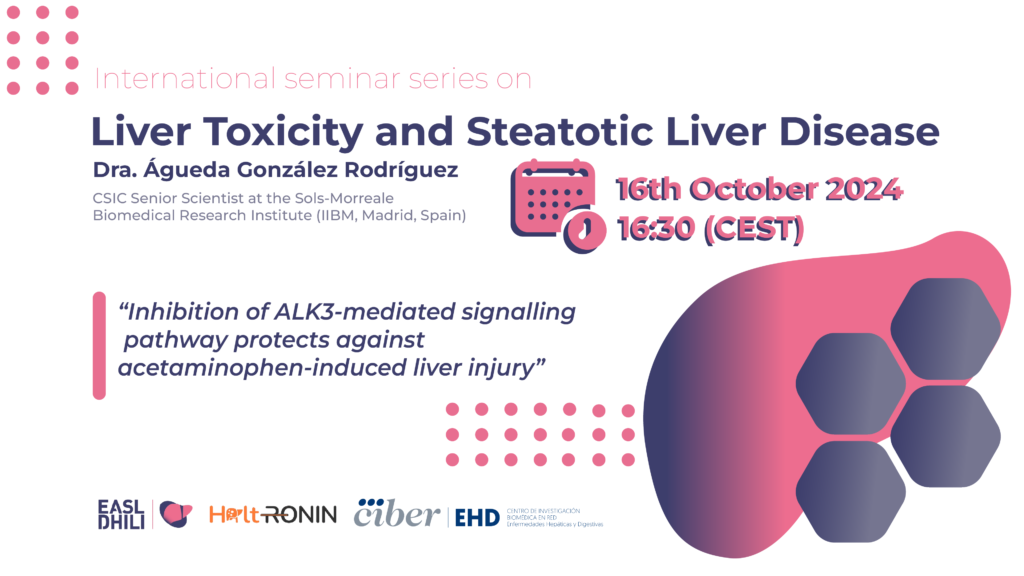
A new seminar of the International Seminar Series on Liver Toxicity and Steatotic Liver Disease. Remember tomorrow, Wednesday October 16th from 16:30h to 17:30h (CEST). Your participation is vital to enrich the discussions, and we look forward to hearing your ideas.
| SAVE THE DATE | |
| Inhibition of ALK3-mediated signalling pathway protects against acetaminophen-induced liver injury | |
|
DATE: 16th October, at 16:30h (CEST) GUEST: Dra. Águeda González Rodríguez REGISTRATION AT THIS LINK: |
|
|
Águeda González Rodríguez obtained the PhD in Pharmacy (2008) at Complutense University of Madrid (Madrid, Spain). She had her postdoctoral training (2008-2014) at the Sols Morreale Biomedical Research Institute (IIBM, Madrid, Spain), a joint center run by Spain’s Higher Science Research Council (CSIC) and the Autonomous University in Madrid, and at the University of Cambridge (Cambridge, UK). From 2015, she heads the Metabolic Syndrome and Vascular Risk research group, firstly at the Health Research Institute Princesa (Madrid, Spain) and, since 2022, at IIBM (Madrid, Spain) as CSIC Senior Scientist, developing a translational “bench to bed/bed to bench” research focused on the study of the molecular basis of Metabolic Syndrome (MetS) and its comorbidities, with a major focus on metabolic-associated steatotic liver disease (MASLD). Moreover, her group studies molecular mechanisms involved in the progression of acute and chronic liver injury, including drug-induced hepatotoxicity. In this regard, her team are investigating the role of bone morphogenetic proteins (BMPs) in the progression of acetaminophen (APAP)-induced acute liver failure (ALF). Indeed, her group was the first to identify the protective effect of ALK3 receptor inhibition against APAP-induced hepatotoxicity, suggesting that BMP signalling might be a new pharmacological target for the treatment of ALF. Current research efforts include the search of new serological biomarkers based on BMPs for prognosis of ALF.