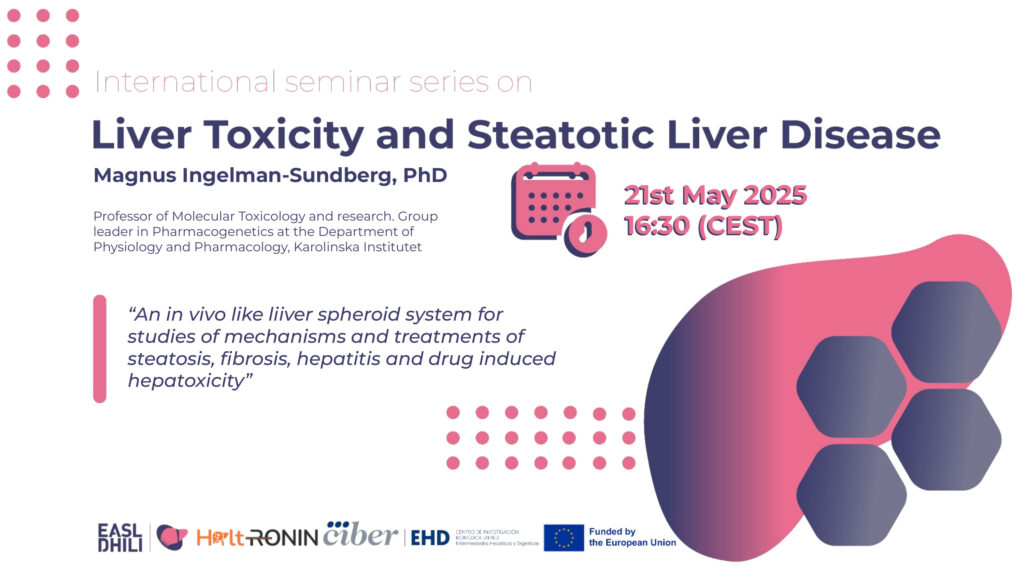
We warmly welcome you to the International Seminar Series on Liver Toxicity and Steatotic Liver Disease. Remember that in order to improve our understanding of the topic and to promote collaboration in our research efforts, we will be organising a series of seminars every month.
Next week, we have a new session, on 21st May (Wednesday) from 16:30h to h (CEST). Your participation is vital to enrich the discussions, and we look forward to hearing your ideas.
| SAVE THE DATE | |
| An in vivo like liiver spheroid system for studies of mechanisms and treatments of steatosis, fibrosis, hepatitis and drug induced hepatoxicity | |
DATE: 21st May at 16:30h (CEST) GUEST: Magnus Ingelman-Sundberg, PhD REGISTRATION AT THIS LINK: | |
|
Magnus Ingelman-Sundberg, PhD; BSc.Med is Professor of Molecular Toxicology and research group leader in Pharmacogenetics at the Department of Physiology and Pharmacology, Karolinska Institutet. He has more than 520 original papers and a h-factor of 101 (ISI/Clarivate) or 132 (Google Scholar). Assigned “Highly Cited Researcher” for 2014-2017 and 2021-2024 by Thomson & Reuters/Clarivate. His research focuses on genetics, polymorphism, regulation, function and toxicology of the hepatic ADME system with aims at understanding interindividual differences in drug response. Furthermore he develops novel hepatic in vitro systems for studying liver function, liver diseases and validation of hepatic drug targets. Summary The lecture will be focused on our development of a 3D liver spheroid system that closely mirrors the transcriptome, proteome, and metabolome of the corresponding donor liver. This model has proven highly effective in: i) predicting and understanding mechanisms behind drug-induced hepatotoxicity, ii) assessing the hepatic disposition and metabolite formation of low-clearance drugs, iii) elucidating the mechanisms of viral-induced hepatitis and the specific actions of viruses within the liver, iv) evaluating mechanisms of hepatocyte proliferation and v) understanding the processes by which a high-fat diet induces liver fibrosis and the molecular drivers of liver fibrosis degradation.
|
|
|